
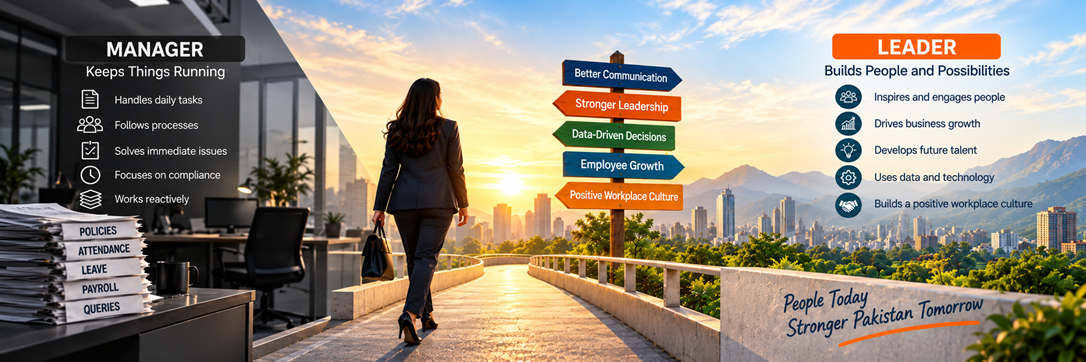
Managing people is no longer enough.
In 2026, HR leaders in Pakistan are expected to do much more than approve leave, manage attendance, handle payroll questions, and enforce policies. They are expected to guide teams, support business growth, develop talent, build trust, and help employees adapt to a workplace that is changing quickly.
The difference between a manager and a leader is simple: a manager makes sure the work gets done, while a leader helps people understand where they are going and why it matters.
For HR professionals, making that shift is becoming essential.
Think Beyond Daily HR Tasks
A strong HR leader should understand how people decisions affect the entire business. That means looking beyond routine administration and asking bigger questions:
Bigger questions HR leaders should be asking:
- Are we hiring the right people?
- Are good employees staying?
- Are managers developing their teams properly?
- Are performance problems being addressed early?
- Are employees learning the skills the company will need next year?
HR leaders should understand business goals, not only HR processes.
When HR understands the company's direction, it can make better decisions about recruitment, training, workforce planning, and employee development.
Build Strong Communication Skills
Communication is one of the most important leadership skills. Employees want clarity. Managers want practical guidance. Senior leadership wants useful insights. An HR leader must communicate effectively with all three.
That means being able to explain policies in simple language, handle difficult conversations professionally, present recommendations confidently, and listen carefully before making decisions.
Good communication also means avoiding unnecessary complexity. Employees should understand what is expected from them without needing to decode long HR messages.
Learn to Listen Before You Lead
Leadership is not only about giving instructions.
Strong HR leaders listen.
Employees often reveal important workplace problems through small comments, repeated complaints, exit interviews, or changes in behavior.
A good leader pays attention. Questions such as:
Sometimes one honest question uncovers what a dozen reports never will.
can reveal problems that reports alone may not show.
Listening helps HR make decisions based on what employees actually experience.
Become Better at Coaching Managers
HR cannot personally manage every employee. That is why HR leaders need to help managers become better people managers.
Many workplace problems begin because a manager does not know how to give feedback, handle conflict, set expectations, or support an underperforming employee.
Instead of solving every issue directly, HR leaders should coach managers on how to handle these situations themselves. This creates stronger leadership across the organization rather than making HR the only department responsible for employee problems.
Use Data, Not Only Instinct
Modern HR leaders need to become comfortable with data.
Important HR metrics can include:
- Employee turnover
- Absenteeism
- Time to hire
- Offer acceptance rate
- Training completion
- Performance trends
- Employee retention
- Leave patterns
- Engagement results
Data helps HR move from "I think there is a problem" to "Here is what is happening and why it matters."
For example, if one department has unusually high turnover, HR can investigate the manager, workload, compensation, career growth, or workplace environment.
Data makes HR decisions more credible.
Understand Technology and Automation
HR technology will continue to play a larger role in Pakistani workplaces. HR leaders do not need to become software developers, but they should understand how technology can improve HR processes.
An HRMS can help automate attendance, payroll, leave, employee records, performance reviews, recruitment, and reporting. Automation reduces repetitive work and gives HR more time to focus on employees and strategy.
The goal is not to replace human interaction. The goal is to remove unnecessary manual work so HR professionals can spend more time on the conversations and decisions that require people.
Lead With Fairness and Consistency
Employees quickly notice when policies are applied differently to different people. Strong HR leaders create trust by being consistent.
Whether the issue involves leave, promotions, attendance, performance, or disciplinary action, employees should understand the process and believe that decisions are being made fairly. This does not mean every situation will have the same outcome.
It means the same principles should guide the decision. Fairness builds credibility, and credibility is essential for leadership.
Develop Future Talent
A good HR leader does not only solve today's staffing needs. They think about tomorrow.
Questions to guide future talent planning:
- Which employees have leadership potential?
- Which skills are missing?
- Which roles may become difficult to fill?
- Who could be promoted internally?
HR leaders should work with managers to identify high-potential employees, create development plans, support training, and build internal career paths.
Employees are more likely to stay when they can see opportunities to grow.
Become Comfortable With Difficult Conversations
Leadership is not always comfortable. HR leaders sometimes need to discuss poor performance, conflict, misconduct, compensation concerns, organizational changes, or difficult decisions.
Avoiding these conversations usually makes problems worse. Strong HR leaders prepare carefully, stay respectful, focus on facts, and communicate clearly.
The goal is not to make difficult conversations harsh. The goal is to make them honest, fair, and productive.
Build a Culture People Want to Stay In
Salary matters, but employees also care about how they are treated. They want respect, recognition, growth opportunities, flexibility, good managers, and a sense that their work matters.
HR leaders play a major role in creating that environment. Culture is built through everyday experiences: how managers communicate, how achievements are recognized, how problems are handled, and whether employees feel heard.
The strongest HR leaders understand that employee experience is not a side project. It is part of business performance.
Final Thoughts
The HR leader of 2026 cannot be limited to administration.
Pakistani organizations need HR professionals who can communicate clearly, coach managers, understand data, use technology, develop talent, handle difficult conversations, and build trust across the workplace.
The shift from manager to leader happens when HR stops focusing only on processes and starts focusing on people, decisions, and long-term impact.
Good managers keep things running.
Great HR leaders help people and businesses move forward.