
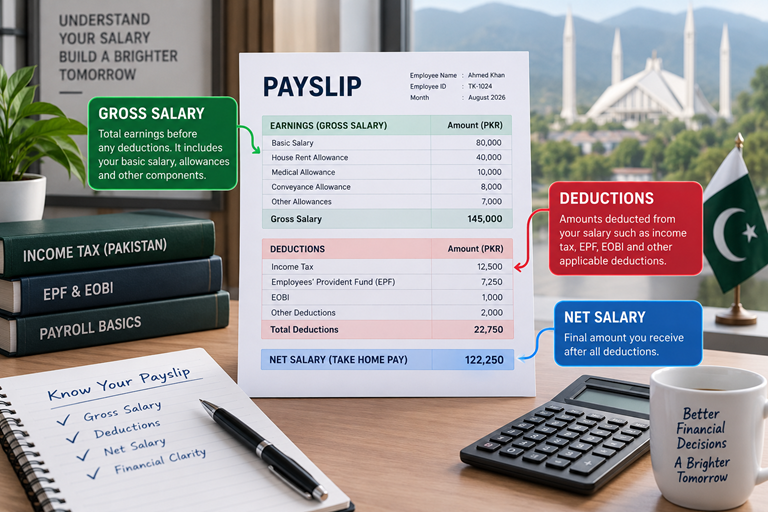
Many employees in Pakistan are surprised when the salary mentioned in their offer letter is different from the amount that reaches their bank account. In most cases, the difference comes from the gap between gross salary and net salary.
A payslip may include basic salary, allowances, overtime, bonuses, tax deductions, provident fund contributions, unpaid leave adjustments, and other payroll items. Understanding these sections helps employees confirm that they are being paid correctly and makes personal financial planning much easier.
What Is Gross Salary?
Gross salary is the total amount an employee earns before deductions are applied.
It usually includes basic salary along with other earnings or allowances provided by the employer. Depending on the organization, gross salary may include:
Gross salary may include:
- Basic salary
- House rent allowance
- Medical allowance
- Conveyance or travel allowance
- Overtime payments
- Performance bonuses
- Other approved allowances
For example, if your basic salary is PKR 80,000 and you receive PKR 20,000 in allowances, your gross salary would be PKR 100,000 before deductions.
Gross salary is useful when comparing job offers, but it does not always represent the amount you will actually receive in your bank account.
What Is Net Salary?
Net salary is the amount an employee receives after applicable deductions and payroll adjustments have been made.
It is often called take-home salary because this is the final amount usually transferred to the employee.
A simple way to understand the calculation is:
Net Salary = Gross Salary – Deductions + Applicable Adjustments
Your net salary may vary from month to month if your payroll includes overtime, bonuses, unpaid leave, attendance deductions, tax adjustments, or other variable components.
This is why employees should review the complete payslip rather than focusing only on the final amount.
Common Deductions on a Payslip in Pakistan
The deductions shown on a payslip can differ depending on the employee, organization, salary structure, and applicable policies.
Common deductions may include:
- Income tax deducted through payroll
- Provident fund contributions
- Employee loan or salary advance repayments
- Unpaid leave deductions
- Attendance-related adjustments where applicable
- Other company-approved deductions
Some organizations may also display statutory or social-security-related contributions depending on employee eligibility and company arrangements.
Every deduction should be clearly mentioned on the payslip so employees can understand how their final salary has been calculated.
How to Read Your Payslip Correctly
A payslip becomes much easier to understand when you review it section by section.
Start with your employee information. Check your name, employee ID, designation, department, and payroll month to make sure the payslip belongs to the correct period.
Next, review the earnings section. Confirm your basic salary and any allowances, overtime, bonuses, or incentives.
Then move to the deductions section. Check income tax, provident fund, unpaid leave, loans, or other deductions carefully.
Finally, review the net salary shown at the bottom of the payslip and compare it with the amount received in your bank account.
If there is an unexpected difference, contact HR or payroll for clarification instead of waiting until the next payroll cycle.
Why Gross Salary Can Create Confusion
One of the most common salary misunderstandings happens during recruitment.
An employee may hear that a position offers PKR 150,000 per month and assume that the entire amount will be received as take-home pay. However, if the figure represents gross salary, deductions may reduce the final amount.
Before accepting a job offer, ask whether the salary being discussed is:
Clarify which figure you're being offered:
- Gross salary
- Net salary
- Basic salary
- Total compensation package
It is also useful to ask which allowances are included and which deductions may apply.
Having this information in advance makes job offers easier to compare and reduces payroll confusion later.
Check Variable Earnings and Adjustments
Not every payslip will look exactly the same each month.
Your salary may change because of:
- Overtime
- Performance incentives
- Bonuses
- Unpaid leave
- Attendance adjustments
- Salary revisions
- Tax adjustments
Employees should compare payslips from different months if they notice a significant change in their net salary.
This makes it easier to identify whether the difference comes from additional earnings, deductions, or an adjustment made during payroll processing.
How Technology Can Make Payslips Easier to Understand
Manual payroll processes can make salary calculations difficult to track, especially when attendance, leave, overtime, and payroll are managed separately.
Modern HR and payroll systems bring this information together in one place. Automated calculations can use approved attendance, leave, overtime, salary structures, and deductions to prepare payroll more accurately.
Employees can also access digital payslips and review their earnings, deductions, and payroll history without repeatedly contacting HR.
With Trackk HRMIS, organizations can manage payroll alongside attendance, leave, approvals, and employee records through a centralized platform. This helps improve payroll accuracy while giving employees greater visibility into how their salaries are calculated.
Final Thoughts
Understanding the difference between gross and net salary is essential for every employee.
Gross salary represents total earnings before deductions, while net salary shows the amount you actually receive after payroll adjustments.
By reviewing your earnings, deductions, allowances, tax, and final take-home amount, you can better understand your compensation and identify payroll issues early.
A clear payslip benefits both employees and organizations by improving transparency, reducing confusion, and building greater trust in the payroll process.