
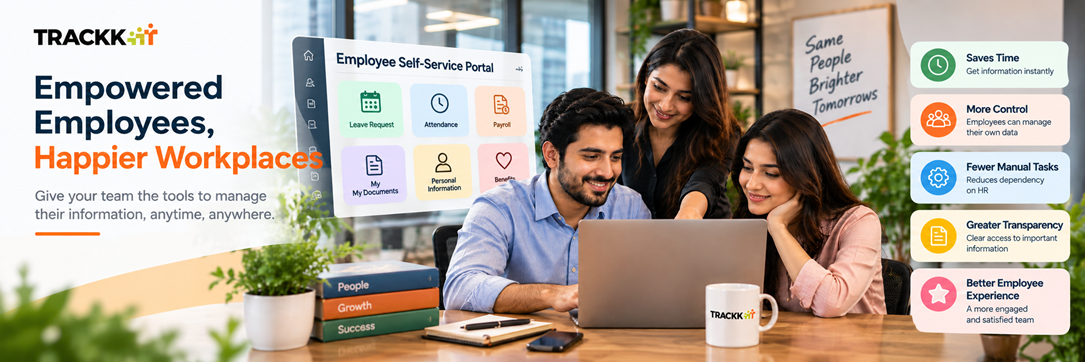
Employees today expect workplace systems to be as simple and convenient as the apps they use every day. They do not want to send an email to HR just to check their leave balance, wait for someone to update their personal information, or ask payroll for the same salary document every month.
This is where an Employee Self-Service, or ESS, portal can make a major difference. An employee self-service portal gives employees direct access to important HR information and routine workplace tasks. Instead of depending on HR for every small request, employees can handle many things themselves quickly and securely.
For growing organizations, this can improve both employee experience and HR efficiency.
What Is an Employee Self-Service Portal?
An Employee Self-Service portal is a digital system where employees can access and manage their own HR-related information. Depending on the system, employees may be able to:
What employees can typically do through ESS:
- View and update personal information
- Check attendance records
- Apply for leave
- View leave balances
- Download salary slips
- Review payroll details
- Access company policies
- Submit reimbursement requests
- View benefits information
- Update emergency contacts
- Track approval requests
- Access performance or training information
The goal is simple: give employees more control over routine HR tasks.
Employees Get Faster Access to Information
One of the biggest advantages of an ESS portal is speed. Without self-service, an employee may need to send an email, message HR, or wait for someone to respond before getting basic information.
For example, an employee may want to know:
A good self-service portal means employees rarely need to ask HR anything at all.
With an ESS portal, the answer is available immediately. The same applies to salary slips, attendance records, personal details, and other information. Faster access means fewer delays and less frustration.
Leave Management Becomes Easier
Leave requests are one of the most common HR activities. With a self-service portal, employees can view their available leave balance, select the leave type, choose dates, add a reason if required, and submit the request directly.
They can also see whether the request is:
Leave request statuses employees can track:
- Pending
- Approved
- Rejected
- Cancelled
This creates more transparency. Employees no longer need to repeatedly ask managers or HR for an update. Managers also benefit because they can review requests in one place and make faster decisions.
Employees Can Manage Their Own Information
Personal details change over time. An employee may change their phone number, address, bank account, emergency contact, or other information. Without self-service, these updates often require forms, emails, or HR staff manually entering the information.
An ESS portal can allow employees to update permitted information themselves. This reduces unnecessary administrative work and helps keep employee records accurate.
Some sensitive changes may still require HR approval, but the overall process becomes much simpler.
Payroll Information Becomes More Transparent
Payroll questions can create a large amount of repetitive work for HR teams. Employees may ask for salary slips, tax information, deductions, allowances, or payment history.
A self-service portal gives employees direct access to the information they are allowed to see. For example, they may be able to view:
Payroll information employees may view:
- Basic salary
- Allowances
- Deductions
- Bonuses
- Overtime
- Tax deductions
- Net salary
- Previous payslips
This makes payroll easier to understand and reduces unnecessary back-and-forth communication.
It Reduces Repetitive HR Work
HR teams often spend a surprising amount of time answering simple questions.
Questions HR answers on repeat:
- "Can you send me my payslip?"
- "How many leaves do I have?"
- "Has my leave been approved?"
- "Can you update my phone number?"
These are important requests, but they do not always require direct HR involvement.
When employees can handle routine tasks through self-service, HR professionals have more time for higher-value work such as hiring, employee development, performance management, compliance, and workplace culture.
It Improves Transparency
Employees feel more confident when they can see their own records. An ESS portal can provide visibility into leave balances, attendance, payroll, requests, and approval status.
This reduces uncertainty. For example, instead of wondering whether an attendance correction was submitted, the employee can check the request directly.
Instead of asking whether a leave request reached the manager, they can see its status. Transparency builds trust because employees are not completely dependent on someone else to tell them what is happening.
It Supports Remote and Hybrid Teams
Self-service becomes even more valuable when employees are not working from the same office. Remote and hybrid employees may not be able to visit HR physically whenever they need something.
A digital portal gives them access from wherever they are, depending on company security policies. They can submit requests, review information, download documents, and complete HR-related tasks without needing to be in the office.
This helps create a more consistent employee experience across different locations.
It Gives Managers Better Visibility
Employee self-service is not only useful for employees. Managers can also benefit from structured dashboards and approval workflows.
For example, managers may be able to see:
What managers can see on their dashboard:
- Team attendance
- Upcoming leave
- Pending requests
- Employee availability
- Approval history
- Basic team information
This helps managers make better decisions and respond faster. If several employees have requested leave for the same period, the manager can identify the situation before approving everything.
Mobile Access Makes It Even More Convenient
Employees increasingly expect workplace tools to work on mobile devices. A mobile-friendly self-service portal allows employees to complete simple HR tasks without opening a laptop.
They may be able to check attendance, apply for leave, download a payslip, or review a request directly from their phone. The easier the system is to use, the more likely employees are to actually use it.
Security and Permissions Still Matter
Giving employees self-service access does not mean giving everyone access to everything. A good ESS portal should use role-based permissions.
Employees should only see their own information and the features relevant to them. Managers may receive additional access for their team, while HR and administrators may have broader permissions.
Sensitive information should be protected through secure authentication, controlled access, and proper system monitoring. Convenience should never come at the cost of data security.
How an HRMS Supports Employee Self-Service
An HRMS can bring employee self-service into one central system. Instead of using separate tools for attendance, leave, payroll, documents, and employee information, organizations can connect these processes in one platform.
Employees get a single place to manage routine HR activities, while HR teams get better records, fewer manual processes, and more consistent data.
Automation can also send notifications when requests are submitted, approved, rejected, or require action. The result is a smoother experience for both employees and HR.
Final Thoughts
Employee self-service portals are not simply about reducing HR workload. They are about giving employees easier access, more visibility, and greater control over everyday workplace tasks.
When employees can check information, submit requests, and manage routine activities without unnecessary delays, the workplace feels more organized and responsive.
For organizations, the benefits are equally important: fewer repetitive tasks, better data accuracy, faster workflows, and stronger transparency.
A well-designed ESS portal turns HR from a bottleneck into a background process.